
This is the fourth in a 6-part series on Entrepreneurial Skills for Social Impact. Parts 1 through 3 covered Vision and People. This piece moves to the third component of the operating system: Data — and why most social impact teams are tracking the wrong things with total confidence.
Chris McChesney, Sean Covey, and Jim Huling open The 4 Disciplines of Execution with a thought experiment: imagine a soccer match where the players can’t see the scoreboard. They’re told to play their hardest, given feedback at the end of the game about how it went, and asked to do better next time. Nobody plays that game with any real intensity, because nobody can tell, in the moment, whether the thing they’re doing right now is working. Compare that to a game where the score is visible throughout. Suddenly effort, strategy, and urgency all shift simply because the players can finally see whether what they’re doing is moving the number they care about.
Most social impact teams are playing some version of that first game. They know the annual numbers they’re supposed to hit — volunteer hours, dollars raised, participation rate — and they find out how the year went roughly the same time everyone else does: at the end of it.
There’s nothing wrong with those numbers. In fact, they’re essential. They tell us whether people are participating, whether programs are reaching employees, whether resources are moving, and whether activity is happening at the scale we intended. The problem is that we tend to ask those numbers to tell us more than they actually can.
Volunteer hours tell us how many hours were volunteered. Participation tells us how many people participated. Dollars donated tell us how much money moved. They tell us volume. They do not, on their own, tell us value.
That distinction is especially important in social impact because, unlike financial reporting, our numbers are not themselves units of value. In financial reporting, $10 million is meaningfully different from $5 million because money is the unit in which financial value is being expressed. Within the appropriate accounting context, more dollars really does mean more financial value.
Ten thousand volunteer hours don’t work the same way.
Ten thousand hours are not inherently twice as valuable as 5,000 hours. A 30% participation rate is not automatically more impactful than a 20% participation rate. One hundred volunteer events do not necessarily create more community value than 50. The numbers tell us how much happened. They don’t tell us what happened because of it.
The Same Output Can Produce Very Different Value
Consider two companies that each report 10,000 volunteer hours. At one company, employees show up, complete useful tasks, take a photo, and go home. The nonprofit receives something it asked for. Employees have a positive experience. Nothing about that is inherently bad.
At another company, employees contribute the same 10,000 hours, but the experiences are intentionally designed around strong nonprofit relationships, appropriate contribution, exposure to new perspectives, skilled facilitation, and reflection. Employees leave with a different understanding of the community. Some build new relationships, develop skills, return to volunteer again, or change how they show up in their workplaces and daily lives.
The output can be identical. The value can be radically different.
This is one reason Realized Worth distinguishes activity from impact. A program can generate thousands of hours without necessarily creating meaningful experiences, strengthening nonprofit partners, developing capable volunteer leaders, or advancing the company’s larger social impact strategy.
And it is also why employees shouldn’t be treated simply as units of volunteer labor. Volunteering can create outcomes for communities and nonprofit partners while also changing the people who participate — their relationships, skills, empathy, sense of purpose, or understanding of the communities around them. Some of those changes are quantitative. Others show up as observable changes in behavior. Both can be meaningful evidence.
Lag Measures Tell You What Already Happened. Lead Measures Tell You What’s About To.
The core distinction in The 4 Disciplines of Execution is between lag measures and lead measures, and it’s a useful idea for social impact teams to borrow.
A lag measure tells you the result: total volunteer hours, total dollars donated, total employees engaged for the year. These numbers are real and they matter to executive sponsors. They give us important information about scale, reach, and results, but they’re of limited use for managing what happens next if the first time we’re really examining them is at the end of the year. Once December arrives, there is nothing we can do to change the preceding eleven months.
A lead measure gives us something different: a signal that is both predictive of the result we want and influenceable by the team doing the work. If we want more employees to participate meaningfully in volunteering, for example, we might track the percentage of new volunteers who complete a second activity within 90 days, the number of Volunteer Activity Leaders who’ve facilitated a debrief conversation with their teams, the number of opportunities being created by volunteer leaders, or the conversion rate from event sign-up to attendance.
Those measures don’t prove impact either, but they do give us something we can manage, and that’s the critical difference. Annual reporting asks, “What happened?” A measurement system should also help us ask, “What is happening now, what is it likely to produce, and what should we do differently while there’s still time to matter?”
Almost every social impact scorecard leans heavily toward lag measures because those are the numbers that show up in annual reports and the numbers executives understandably ask for. But a team that wants to influence those results needs to identify the lead measures sitting underneath them and manage those on a regular cadence.
If your dollars-raised number is soft, the actionable measure isn’t “raise more money.” It might be manager participation in campaign kickoffs or the number of peer-to-peer asks sent per employee, something specific enough to actually manage day to day.
One-Dimensional Measurement Isn’t Enough
This is where the distinction between lead and lag measures becomes part of a bigger measurement system. Think about it as a line of sight:
Vision → Big Goal → Contributing Goals → Lead Measures → Lag Measures → Outcomes & Impact
Every layer should trace back to the one above it. If a measure can’t be traced to a goal, and the goal can’t be traced to the vision, it is data, not strategy. This is an important distinction because it changes the question from “What can we count?” to “What are we trying to make true?”
If our goal is 10,000 volunteer hours, we can optimize for hours. But why do we want 10,000 hours? Presumably because we believe those hours will produce something: greater capacity for nonprofit partners, progress on a community issue, stronger relationships, new employee skills, greater empathy, stronger connection to the company, or some other meaningful change. Once we articulate that change, we can work backward.
What would have to become true for us to achieve it? What results would indicate we’re making progress? What activities and conditions are likely to produce those results? Which of those can we influence right now? Now the 10,000 hours have context. They’re no longer being asked to prove impact. They’re one piece of evidence in a larger theory about how impact happens.
This is familiar logic-model territory: resources lead to activities, activities produce outputs, outputs contribute to outcomes, and outcomes can contribute to longer-term impact. And it means a useful social impact measurement system needs to look beyond participation alone. RW’s framework considers four dimensions: leadership competency, individual engagement, program capacity, and program results. Together, they help us ask not only whether people showed up, but whether the people leading them were equipped to create meaningful experiences, whether employees were meaningfully engaged, whether the program developed the capacity to operate effectively at scale, and whether the work produced the outcomes we intended.
The Gap Between Strategy and Results
Larry Bossidy and Ram Charan spent Execution making an argument that sounds almost too obvious to need a book: most strategies fail not because they were the wrong strategy, but because nobody built the operating discipline to actually carry them out. The gap between intention and result gets closed only by a cadence of accountability: someone looking at the actual numbers, on a schedule, asking what’s working and what needs to change before the annual report locks in the answer for everyone.
And this is where measurement becomes much more than reporting. A good measurement system doesn’t simply tell us whether the number went up or down. It gives us information early enough to learn from it. If the lead measures are moving but the lag measures aren’t responding, maybe our assumption about what drives the result was wrong. That’s what it looks like when a good measurement system gives us information while there’s still time to change the activity, invest in capacity, remove a barrier, or reconsider the goal.
This is the piece most social impact measurement systems skip entirely. The KPIs (if there are KPIs at all) get set at the start of the year, presented at the end of the year, and mostly ignored in between, because nobody built a rhythm for checking them in the months where checking them could still change the outcome.
What This Looks Like in Practice
Pick one number your team reports every year. Let’s use total volunteer hours. Now ask a different set of questions:
First: Why do we care about this number? What do we believe will be different because those hours happened? If we can’t answer that question, we’re probably measuring activity without having articulated the value we’re trying to create.
Second: What result would give us evidence that the change actually occurred? That might be increased nonprofit capacity, repeat employee engagement, stronger volunteer leaders, changes in employee behavior, progress against a specific community outcome, or something else entirely.
Third: What makes that result more likely? Those are your potential lead measures. What can the team influence this month that you genuinely believe predicts the result?
Then look at all three together.
- Output: What happened and at what scale?
- Lead measures: Are we doing the things we believe will produce the desired result?
- Outcomes and impact: What changed because the activity happened?
Now you have something much more useful than a year-end KPI dashboard. You have a hypothesis about how your work creates value and a way to test that hypothesis while you’re doing the work.
Review lead measures frequently. Review lag measures periodically. And don’t just record the numbers; record the decision the numbers caused you to make.
Your KPIs Probably Aren’t Actually Lying
Maybe that’s the irony of the title. Your volunteer-hours number probably isn’t lying to you. Neither is your participation rate, your dollars donated, or your number of events. They’re probably telling you exactly what they’re capable of telling you.
Hours tell us hours. Participation tells us participation. Dollars tell us dollars. They tell us volume. Value requires more evidence. This is why measurement is an entrepreneurial skill.
Entrepreneurs can’t afford to wait until the end of the year to find out whether their idea worked. They form hypotheses about what will create value, identify the signals that will tell them whether they’re right, watch those signals closely, and adjust when the evidence tells them something isn’t working. Social impact leaders need to operate the same way.
Our strategy is also a set of hypotheses: If we build this capability, create these experiences, engage people in these ways, and invest these resources, we believe something meaningful will change. Measurement is how we test those assumptions.
That requires more than reporting the numbers we’re accustomed to reporting. It requires the discipline to distinguish volume from value, outputs from outcomes, and the results we ultimately want from the behaviors we can influence today. It means choosing measures because they help us make decisions and not simply because they’re easy to count or expected in the annual report.
And when the data challenges our assumptions, entrepreneurial leadership means being willing to change course. If the lead measures move and the lag measures don’t, we learn something. If participation grows but the experiences aren’t meaningful, we learn something. If we’re generating enormous activity without creating the outcomes we intended, we learn something.
Data sits in the entrepreneurial operating system alongside Vision and People. Vision tells us what we’re trying to make true. People give us the capability to make it happen. Data tells us whether our assumptions about how to get there are actually holding up while there’s still time to do something about it.
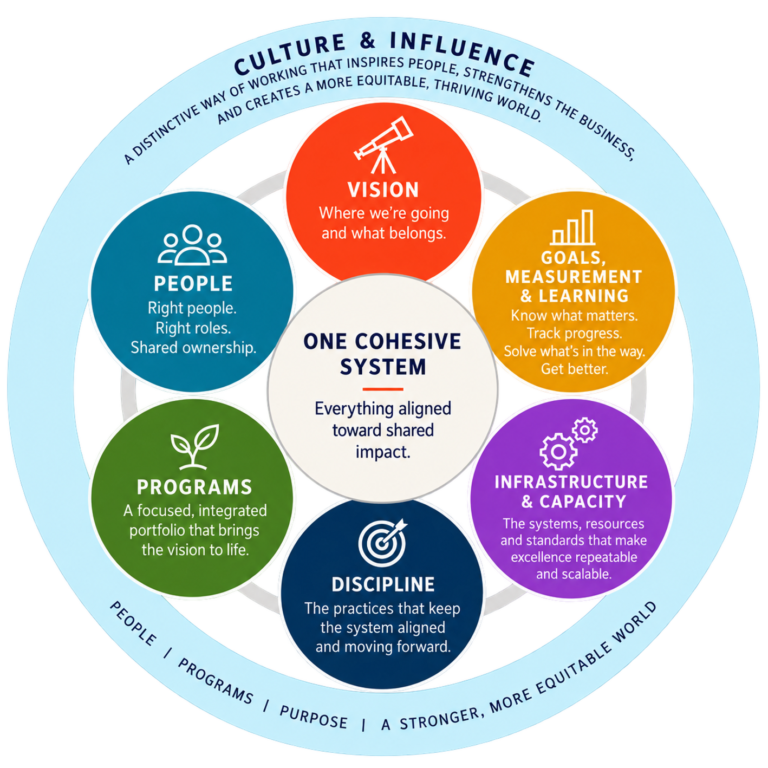
This series is the manual for Entrepreneurial Skills for Social Impact. We’ll publish it in six components, each paired with frameworks you can use, books you might want to read, and the business thinking that you need to succeed. Next up: Process — and why your Support Systems deserve the same design discipline a product team gives an actual product.
Want to legitimize this further with us? We hosted a RealTalk webinar on The Entrepreneurial Skills Every Social Impact Leader Needs where we walked through the full operating system and took questions from social impact leaders building their own function within their companies.