
This is the first in a 6-part series on Entrepreneurial Skills for Social Impact. It’s a practical case for why the discipline of building a startup is the same discipline required to build a social impact function that lasts. Each piece pairs a component of the operating system with the business thinking and Realized Worth frameworks behind it.
If you know me, you know I love a good business memoir. One of my favorites is Phil Knight’s Shoe Dog. It’s an old-school story of entrepreneurship. It’s pre-Silicon Valley, pre-billion-dollar valuations, pre-build-and-sell-as-fast-as-you-can and then do it again. It’s when one person’s idea to share their passion became a way to do what they loved for the rest of their lives — and to make money at it, too!
The thing I love about Phil Knight’s story in particular is that he didn’t just set out to build a shoe company. He actually set out to prove a theory! He believed that Japanese running shoes could out-engineer German ones, and that a market nobody had even thought about was wide open with opportunity. He had a car trunk, a handshake deal, and no idea what he was doing most of the time. Against the advice of his parents, friends, and mentors, he built Nike — one impossible cash-flow crisis at a time. Nobody had given him a manual, there was no set of instructions to follow, no “right” way or tested best practice. It was a mad mission, but he had something to prove, so he stuck with it — and eventually, he came out victorious.
As an entrepreneur, I relate with parts of this journey, and I think social impact practitioners can probably relate with it too.
Most people I know who work in corporate social impact showed up with a passion to do something good in the world, and to do so in a way that allows them to make a decent living. Most of them worked hard for a highly sought-after CSR role at a large company, and when they eventually got it, the pressure was high to prove that they and the role itself were worth the investment. When they started work on the first day, almost all of them will tell you they found a not-so-well-oiled machine — some combination of outdated approaches to philanthropy, clunky tech tools, inconsistent policies, and a disparate national or global strategy. The point is: nobody handed them a cohesive portfolio, a clear set of standardized practices, or a five-year plan. Corporate social impact practitioners build the plane while flying it, the same way every founder does – but they rarely describe their jobs that way.
That’s the reframe I want to propose. As social impact leaders, you are not administering a program on behalf of the company. You are founding, building, and scaling an organization inside the organization, and every discipline that separates a successful startup or small company from one that fails applies directly to you.
The Founder You Didn’t Know You Were
Ben Horowitz opens The Hard Thing About Hard Things (an entrepreneurship book that I highly recommend!) with a warning that there’s no formula for the decisions that actually matter. There’s no formula for the decisions with no standardized answer, the ones where you’re the only person who can make the call and you’re not sure you’re right. Anyone who has tried to convince a business unit leader to release their team for a volunteer day during a crunch quarter, or fought to keep a program funded when the budget owner rotated out, knows exactly what that feels like. It doesn’t feel like program management. It feels like not enough resources, an audience that has to be won over, and a business case you have to make yourself because nobody’s going to make it for you. Even the industry data doesn’t always help that much.
The instinct, when you’re in that position, is to work harder. Take on more of the load personally. Build the deck yourself, run the pilot yourself, manage the volunteer leader relationships yourself — because it’s faster than explaining it to someone else and hoping they get it right. Jim Collins has a name for what that instinct produces if you don’t catch it: the “genius with a thousand helpers.” This refers to a single brilliant, overworked leader surrounded by people executing instructions rather than building capability of their own. It looks like dedication and productivity, but it’s actually a structural failure waiting for the moment that leader leaves, burns out, or simply runs out of hours.
The alternative isn’t working less (although that may be necessary too). The alternative is to build differently, the way a founder has to once the company outgrows what one person can carry alone.
The Organization You’re Building
Gino Wickman’s Traction breaks a business down into six components: Vision, People, Data, Process, Traction, and Issues. It’s become the operating system for tens of thousands of small companies precisely because it doesn’t ask a founder to be a genius. It asks them to build six specific muscles, in a specific order, and to keep building them as the company grows.
Vision becomes the case for why your function exists at all, nested inside the company’s larger purpose. It’s the founding story your team and your volunteer leaders should be able to articulate in their own words.
People becomes the structure that clarifies who does what parts of the work. You can think of this as the executives who advocate for you, the team you lead directly, and the full network of volunteer leaders whose enthusiasm and expertise make the work work. The key is to build it so that it doesn’t depend on you being the smartest (or the hardest-working) person in the room
Data becomes a measurement system, built on the same logic Franklin Covey uses in The 4 Disciplines of Execution, plus a few other helpful frameworks that we recommend integrating. Essentially, this is a handful of goals that lead to business-aligned impacts, tracked with the measures that predict success rather than just the ones that report it after the fact.
Process becomes the essential support systems that lay a solid foundation under your programs: recognition, training, communications, technology, and program management, designed the same way a good product team designs a product for meaningful, business-aligned growth and scale.
Traction becomes the actual rhythm of meetings and accountability that runs your team and your volunteer network. Let’s be clear: the way your team operates internally is just as important as the programs you execute externally.
Issues become a formal discipline for naming the problem everyone already sees and nobody has time to solve.
The Permission You Need
Phil Knight didn’t know he was building an operating system when he was driving shoe samples around Oregon and distributing them out of his trunk. He just knew the thing he was building mattered enough to keep going without a how-to guide. Social impact leaders have been doing the same thing, probably longer than they’ve given themselves credit for.
This series is the manual for Entrepreneurial Skills for Social Impact. We’ll publish it in six components, each paired with frameworks you can use, books you might want to read, and the business thinking that you need to succeed. Next up: Vision & why the story you tell matters as much as the results it produces.
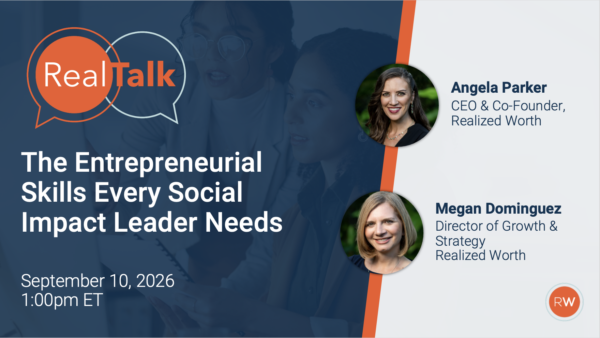
Want to legitimize this live with us? Realized Worth is hosting a RealTalk webinar on The Entrepreneurial Skills Every Social Impact Leader Needs on September 10, 2026, where we’ll walk through the full operating system and take questions from social impact leaders building their own function within their companies.