
This article draws on What the Transformative Approach Brings to Empathy Work, a research brief on the neuroscience of empathy and how to effectively build it into corporate volunteering programs. If you want to dive into the underlying evidence, you can find it — along with our other research — on our Resources page.
Open almost any impact report and find the spot where employee volunteering becomes a table. Employees, hours, dollars, partners, projects completed. Usually a photo of good people in matching shirts.
CSR managers need that table. Leaders ask for it, annual reports run on it, and a budget is easier to defend when the activity is visible. None of that is the problem.
The problem is that a table is a strange place for a human experience to end.
Volunteering should let a company say three things: what changed in the community, what changed inside the business, and what changed in the employee who showed up. The first two usually get room to breathe. The third comes back thin, if at all.
The range is wide. One employee leaves with a good feeling, a photo, and a line on a dashboard, and that is the whole of it. Another leaves with something that keeps working within them afterward, a shift in what they believe about who they are, who other people are, and what they owe the world they just stepped into.
That second outcome is where the real value lives. It is the self-understanding that can start to form when the experience is built for it. Activity, optics, and a warm feeling on the bus home will not carry it there alone.
Companies count activity better than they explain change
This is not carelessness on anyone’s part. Activity is just easier to count than change.
YourCause says it plainly in its piece on impact reporting: hours volunteered, dollars donated, and communities reached are output measures you can see, while outcomes are the real changes those activities produce. The same team notes that CSR groups are under growing pressure to measure impact, and its 2025 CSR Insights Survey points to rising demand for impact measurement and a clearer business case.
CECP’s Giving in Numbers: 2024 Edition gives the field a solid benchmark for participation, hours, program offerings, matching gifts, and the other visible measures. Those benchmarks help CSR teams see where investment and participation are moving. They also mark the edge of the usual scorecard, because a participation rate can confirm that something happened without saying anything about what the experience asked of the people who were there.
The pressure on the field is real and rising. ACCP’s 2025 CSR Insights coverage reports that CSR practitioners are gaining internal visibility, and Blackbaud’s summary of the same survey says more CSR professionals are being asked to tie their work to business value. The ask, in other words, is to explain not just activity, but impact.
That pressure can actually help, if it pushes the field past an old habit. Employee volunteering has been reported for years as something employees do. The more useful question is what the experience helped them come to believe because they did it. And did that belief change into observable behaviors?
The full picture is community, company, and employee
A serious volunteering strategy has to hold three kinds of change at once, and lose none of them.
The work has to create real value with the community. It has to matter to the company in a way it can name without flinching. And it has to form the employee in some way that lasts past the event.
Each question does a job. The community question keeps the whole thing from quietly becoming employee development with a service label. The company question keeps it from being filed away as a nice activity with no strategic weight. The employee question keeps volunteering from shrinking down to labor, logistics, and a headcount.
The community comes first, and not as a courtesy. Employee meaning does not count for much if the experience pulls stories, labor, or emotional value out of other people without any real contribution flowing back. Get that wrong and nothing else is worth discussing.
Still, the employee question deserves more attention than it usually gets. CSR teams tend to ask whether people were satisfied, whether they would do it again, whether the event felt worthwhile. Fair questions. They just stop one layer short of where volunteering can become formative.
One employee leaves thinking, “I helped today.” That sentence is worth something.
Another employee leaves with a different sentence taking shape inside them. Usually in the form of a question forming for the first time: “Am I someone who can walk into an unfamiliar conversation, stay humble, and stay present?” Or, “Am I able to carry more responsibility than I thought I could?” Or, “My work and my citizenship are not as separate as I assumed.” That second kind of sentence is not a post-event mood. It is the start of formation.
Transactional volunteering leaves meaning to chance
Realized Worth has long worked from a distinction between transactional and transformative volunteering. This is not a verdict on the motives of CSR managers or nonprofit partners. Almost everyone in this field is trying to do good work inside real constraints, and most of them are doing it well.
The distinction is about design, not intent.
Transactional volunteering tends to stop at the activity. Employees arrive, complete a task, feel good about helping, and go home. The program can be well run, the nonprofit grateful, the work useful. The catch is that the meaning of the experience gets left almost entirely to whatever the employee already believed walking in.
If someone already reads volunteering as charity, the event tends to confirm the charity frame. If someone already sees community need as something that happens at a safe distance from their own life, the event can leave that distance right where it was. If someone already thinks of themselves as a generous helper, the event can reinforce the helper role without asking anything harder of them.
So transactional volunteering carries a quiet weakness. It can generate plenty of activity while leaving the story employees tell about themselves untouched. It can deepen the line between helper and helped. It can treat showing up as the finish line and waste most of what the experience could have done. And it measures the parts that are easy to measure while missing the only thing that matters here, which is whether anyone’s perspective, belief, or behavior actually started to move.
The issue, again, is rarely intent. More often the architecture is just too thin to hold the outcome being claimed for it.
Transformative volunteering treats the experience as a setting for formation
Transformative volunteering starts from a different question. Not only what will employees do, but what conditions help employees make meaning out of what they do. Once the question changes, the work behind it changes too. Volunteering stops being an event to manage and becomes a setting where people can turn into different kinds of participants in their work and their communities.
This connects directly to transformative learning theory. Jack Mezirow’s work on transformative learning argues that adults can revise their frames of reference through disorienting experience, critical reflection, and what he calls perspective transformation. In plainer terms, people sometimes change because an experience refuses to fit the story they already had, and someone helps them work through the gap.
Mezirow is not the whole Realized Worth approach. He is one foundational piece inside a wider architecture that also draws on behavioral science, social psychology, neuroscience, facilitation practice, and organizational systems. What his work does well is explain why meaning-making is the hinge.
Employees do not become different just because they spent two hours near a social issue. They may become different when the experience unsettles an assumption, puts them in a real encounter, and helps them think through what that encounter is asking of them. Formation starts in that movement, not in the activity itself.
Meaning-making is not “the event felt meaningful”
CSR language tends to use meaning in a soft register. Meaningful work, meaningful engagement, meaningful impact. The words are not wrong. They just go flat fast.
In the transformative approach, meaning-making is a more specific thing. The participant does the work of building significance out of the experience. What happened here? What did I expect? What surprised me? What does that gap show me? What does it ask of me now? Those are not rhetorical questions. They are the work.
“The Empathy Project: One Million Hours of Empathy” is the applied case for the argument in these two pieces. It is a structured volunteering experience built around one-to-one conversations across difference, and the research behind it is gathered in a white paper that supplies a good part of the evidence in this article.
We wrote a technically accurate and science-heavy white paper that makes the point through the language of motivated empathy, drawing on Jamil Zaki’s motivated account of empathy. People do not simply have empathy or lack it. They move toward or away from empathic engagement partly based on whether it feels rewarding, costly, overwhelming, or tied to who they understand themselves to be.
An employee can finish a volunteer activity and never fold it into self-understanding. The event stays episodic. It happened, it was good, and then it was over. Meaning-making asks for more, because it ties the encounter to identity, values, agency, and what the person does next. That is the move from “I attended” toward “I am someone who can show up differently.”
Mutuality keeps formation from turning inward
Talking about employee formation carries a real risk. Push it too far and the community starts to sound like scenery for employee growth. That would be a failure, not a feature.
The transformative approach leans on mutuality to keep that from happening. The work has to rest on real community value and reciprocal contribution, a shared space where everyone gives what they can. In the Empathy Project, employees and global conversation partners are co-volunteers. Both sides put in time, attention, presence, perspective, and lived experience toward a public-good purpose. That is why it sits squarely in the volunteering lane.
It should not be mistaken for a training module with a few human stories bolted on, a webinar about empathy, or employee development wearing a service costume. It is a structured volunteering experience where people give time and attention to a shared human encounter, guided reflection, and public learning about empathy across difference — the same principle behind our practice of Un-Othering.
The public description calls it a six-week, six-hour virtual volunteering experience built around one-to-one conversations, guided reflection, and champion-led Debrief. That structure refuses to treat empathy as a feeling employees consume. It treats empathy work as something people do together. The wording sounds small, but what follows from it is not.
What employees come to believe about themselves
The deepest outcome of employee volunteering may not surface in the first survey after an event. It tends to surface in language.
The white paper points to the gap between event-language and identity-language. Event-language sounds like, “I helped at a food bank today.” Identity-language carries its weight somewhere else: “I am someone who works directly with people experiencing food insecurity.”
The shift is not cosmetic. Research by Grube and Piliavin on volunteer role identity found that as people develop a volunteer identity, their behavior becomes more self-sustaining. McAdams and McLean’s work on narrative identity helps explain the mechanism underneath it: people make sense of who they are through the stories they build about their own lives.
CSR managers do not need to turn every volunteer experience into a research study. They can start by listening for one difference, between employees who only describe what they did and employees who are starting to describe who they are becoming. That tells you more than a satisfaction score ever will.
What this means for CSR managers
None of this means abandoning the outputs. Keep the hours, the participation rates, the partner counts, because those measures still matter, and you will still be asked for them. Forever probably.
Just stop treating them as the whole story.
A stronger volunteering strategy should be able to speak to three layers of change: what changed with the community, what changed for the company, and what changed in the employee. The employee layer should not stop at satisfaction. It should ask whether the experience helped people revise how they see themselves in relation to others.
Transactional volunteering leaves that to chance. Transformative volunteering is built with the intention of creating conditions where it is most likely to occur.
The next question is how.
What comes next
Part 2 of this series takes up the “how” directly. It walks through the facilitation sequence at the center of the Transformative Approach: Brief, Guided Experience, and Debrief. Each stage has a specific job.
- The Brief frames the human meaning of an encounter before employees begin interpreting it through whatever assumptions they already hold.
- The Guided Experience preserves agency and mutuality inside the encounter itself.
- The Debrief helps the experience become self-understanding rather than a memory that slowly fades.
The component-level science behind each stage is strong, and Part 2 shows what it looks like in practice.
Check out the Empathy Project
If you want to get oriented in the Empathy Project before reading Part 2, two places are worth a look.
- The Empathy Project gives you the public overview: what it is, who it is for, and how companies are using it.
- The Complete Picture goes deeper into the coalition model, the co-volunteer design, and the case for reaching one million volunteer hours.
Further reading for CSR managers
- YourCause, “Impact Reporting: The Importance of the Outcome”
Why it matters: A plain-language take on the output-versus-outcome distinction that CSR managers are already being asked to work through. It frames why volunteer hours and dollars are useful but only part of the story.
- YourCause, “How Corporations Can Measure Social Impact”
Why it matters: This one ties the measurement conversation to the pressure CSR teams are feeling right now, including the demand to show impact and business value. It grounds the opening reporting gap in what practitioners actually face.
- CECP, Giving in Numbers: 2024 Edition
Why it matters: CECP lays out the field’s core benchmarking language, from participation rates and hours to program types and matching gifts. CSR managers need these benchmarks, and the same report shows why another layer of meaning and outcome measurement has to sit alongside them.
- ACCP, 2025 CSR Insights Report coverage
Why it matters: ACCP names the rising visibility and pressure landing on CSR teams. That context matters, because the case for transformative volunteering has to help practitioners explain value inside the business, not just design better experiences.
- Blackbaud, “New Social Impact Survey”
Why it matters: This summary shows CSR teams being asked to connect their work to business value. That pressure makes the employee formation layer more important, and more risky if anyone overclaims it.
- Realized Worth, “From Volume to Value: The Framework for Transformative Volunteering”
Why it matters: A direct Realized Worth source for the shift from volume to value and from activity to impact. It works as a companion piece for readers who want the broader transformative volunteering frame.
- Mezirow, Transformative Dimensions of Adult Learning
Why it matters: Mezirow gives one foundational account of why reflection can change a person’s frame of reference. CSR managers do not need to become adult-learning theorists, but this explains why reflection is not decoration you can cut.
- Zaki, “Empathy: A Motivated Account”
Why it matters: Zaki helps explain why empathy is not just a trait or a feeling. People move toward or away from empathic engagement depending on meaning, cost, reward, and motivation. That bears directly on repeat participation and sustained prosocial action.
- Grube and Piliavin, “Role Identity, Organizational Experiences, and Volunteer Performance”
Why it matters: This source connects volunteering to identity. It backs the idea that the deeper employee outcome is not feeling good after an event, but developing a self-understanding that can carry future behavior.
- McAdams and McLean, “Narrative Identity”
Why it matters: This gives CSR managers a way to read Debrief language as evidence. The stories employees tell about the experience can show whether it stayed an event or started to become part of who they are.
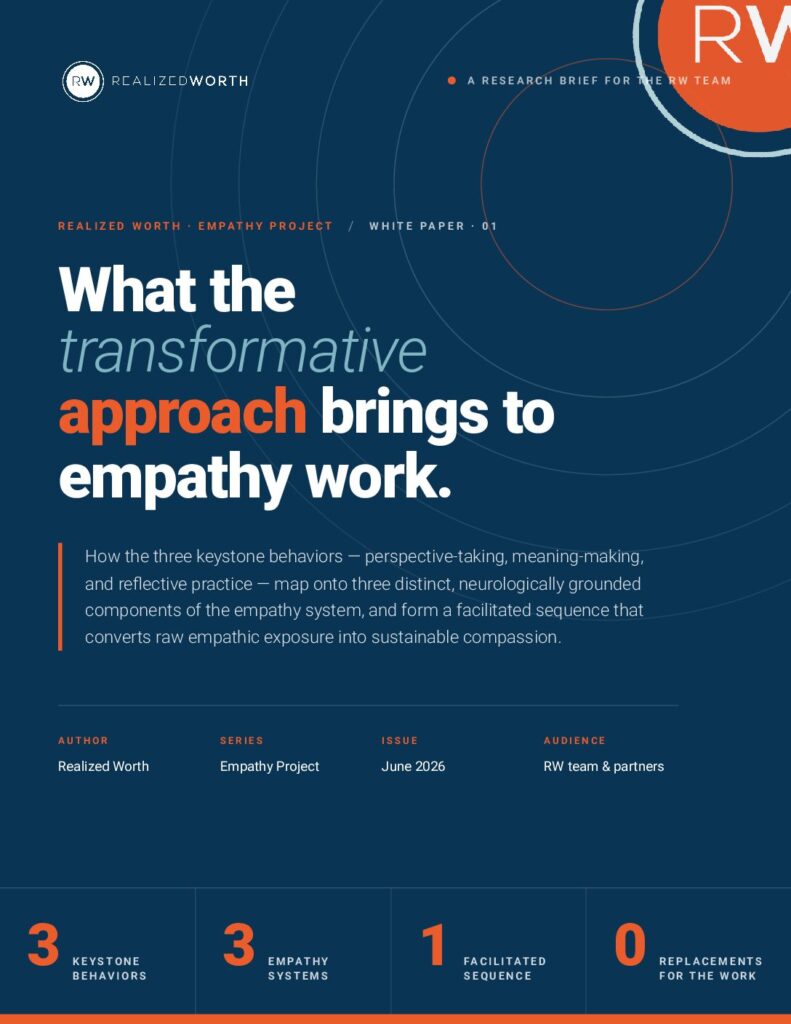
Want the research behind this article?
Download What the Transformative Approach Brings to Empathy Work — Realized Worth’s free research brief on the neuroscience of empathy and how to design volunteering experiences that build it.