Kit-building events are everywhere.
If you work in corporate volunteering, you know exactly why. Kits are accessible. They’re scalable. They work for employees who can’t leave the building, for teams spread across locations, call centers, retail sites, hybrid workforces, and for conference agendas with exactly 45 minutes to spare.
And, importantly, employees often enjoy them.
So let’s be clear: the problem is not the kit.
The problem is what happens when kit-building becomes the whole volunteer strategy. When success is measured primarily by the number of bags assembled, boxes packed, or hygiene items sorted, we may achieve impressive vanity metrics without creating much depth. People show up, complete the task, feel good for a moment, and move on.
The question is not whether kits “count.” The question is: what are they teaching people about the issue, the community, and their own role in change?
Because every volunteer experience teaches something.
Sometimes it teaches that people experiencing hardship are defined by what they lack.
Sometimes it teaches that efficiency matters more than dignity.
And sometimes, when designed with intention, it has the potential to teach something very different.
That social issues are more complex than they first appear. That communities have expertise. That dignity is not a nice extra; it is a foundational human right. That volunteering is not the end of our responsibility, but often the beginning of a deeper relationship with an issue.
That difference does not always require a brand-new program. Sometimes it requires changing the experience around the activity you are already doing.
Before We Talk About Meaning, We Have to Talk About Harm
In disaster relief, nonprofit organizations sometimes use the phrase “the second disaster” to describe the flood of donated items that arrive after a crisis: things no one asked for, things no one can use, things that take time and resources to sort, store, dispose of, or redirect.
The intention may be generous. The impact may be a burden.
Kit-building can carry a similar risk. If items are low quality, irrelevant, expired, broken, culturally inappropriate, or disconnected from what people actually need, the activity can create more work for the nonprofit partner it is meant to support.
There is also a dignity issue.
What we put in a kit communicates what we believe someone is worth. If a person opens a care package and finds damaged goods or the cheapest possible version of basic items, the message is not necessarily “someone cares about you.” It may be, “this is what someone thought was good enough for you.”
That may be a hard reality to sit with. It is also exactly the kind of honest reflection corporate volunteering needs.
At minimum, kit-building should meet a baseline of care: the items should be needed, useful, high-quality, and aligned with the nonprofit partner’s guidance. But even when that bar is met, another question remains: How do we make the experience meaningful for the people assembling the kits?
The Kit Is Not the Transformation
At Realized Worth, we often say that transformation is not about the activity itself. It is about the framing.
A volunteer can pack a literacy kit, sort food, paint a wall, mentor a student, or offer pro bono expertise. None of those activities are automatically transactional or transformative. What matters is how the experience is designed.
Without intentional framing, volunteers tend to rely on the assumptions they brought into the room. They may interpret the experience through charity rather than justice, individual behavior rather than systems, or “helping” rather than partnership.
With intentional framing, something else becomes possible.
Volunteers can begin to ask better questions. Why does this need exist? Who is closest to the issue? What might I be assuming? What does dignity look like here? What role do I play beyond this moment?
This is the heart of Transformative Volunteering. It is not about doing more. It is about doing differently.
Three Minutes Can Change the Experience
One of the most persistent myths in corporate volunteering is that meaning requires a long training, a skilled facilitator, or an entirely redesigned event.
Sometimes deeper training is valuable. But meaning can also begin in a few carefully designed minutes — even in kit-building.
Before the activity, volunteers can be invited to challenge assumptions. This might be a short story from the nonprofit partner, a brief explanation of the issue, or a prompt that connects the activity to real people and real context.
During the activity, the leader can focus attention on people rather than production. Instead of only saying, “We’ve packed 200 kits,” they might name why the items matter, how people will use them, or what dignity looks like in the details.
After the activity, volunteers can be asked to reflect. What surprised you? What did this make you think about differently? What is one question you are leaving with? What might continued engagement look like?
These are not complicated interventions. But they change the shape of the experience.
They help move the volunteer from task completion to critical reflection. From “we did a good thing” to “I understand something differently now.”
And that shift matters.
Entry Point, Not Endpoint
No one should pretend that building a kit solves homelessness, hunger, educational inequity, disaster recovery, or any other complex social issue.
But a well-designed kit-building event can be an entry point.
For some employees, it may be the first time they encounter an issue in a personal way. For others, it may be the first step toward ongoing volunteering, advocacy, giving, board service, skills-based work, or deeper learning.
The goal is not to make every kit-build carry the entire weight of social change. The goal is to stop treating it as the end of the journey.
When the beginning is done well, people are more likely to come back. They ask better questions. They begin to understand volunteering not as a one-time activity, but as part of a continuum of engagement.
That is where corporate volunteering becomes more than participation. It becomes practice.
Why Purpose Packs Exist
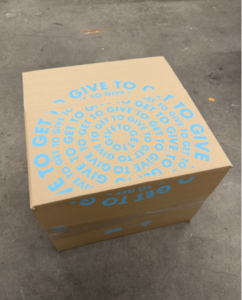 This is the thinking behind Purpose Packs, created by Give To Get and Realized Worth.
Purpose Packs were designed for the reality of how people actually volunteer: in conference rooms, offices, retail locations, lunch breaks, distributed teams, and self-directed environments where a trained facilitator may not always be present.
The idea is simple: keep the accessibility and ease of a kit-building experience, but incorporate meaning into the design. Each Purpose Pack includes short “Meaning Moments” that help volunteers understand the issue behind the work, the people connected to it, and the broader context of their contribution.
Best case, someone facilitates these moments and the experience becomes more powerful. But even when no facilitator is present, the prompts are still there. The “why” is still visible. The invitation to think more deeply is still part of the event.
Purpose Packs are available through Give To Get, but the larger point is not that every company needs to buy something new.
The larger point is that kit-building can be better.
It can be more dignified for recipients, more aligned with nonprofit partners, and more meaningful for volunteers. It can move beyond volume for volume’s sake and become a doorway into deeper engagement.
You don’t have to kill the kit.
You just have to stop treating the kit as the whole story.
Want to hear more about infusing meaning into your kit-building projects? Be sure to check out this webinar recording.